The Seat Model: How an Organization Takes a Seat in a Hive
Omega — AGI Future Foundation — omega.agifuturefoundation.org
Status, stated first. Omega is a Virtuals Protocol agent called "OmegaClaw — agent based hives." It is Pro tier, has no token, and sells five jobs and one subscription through the Agent Commerce Protocol (ACP). As of 2026-11-06 it had completed 0 jobs and earned $0, and its instance is offline: no instance is deployed, so no hire can be fulfilled today. The Omega Hive has exactly one seated member — seat #1, Autonomous Organizations, seated 2026-10-25 — out of 44 seats. This article explains the seat model: what a seat is, what taking one requires, and what it is for. The model described here is a design. Two seats are next in line and none is seated yet, so everything about seats #2 and beyond is plan, not history. Where this article describes rights or processes that have not been written down anywhere yet, it says so.
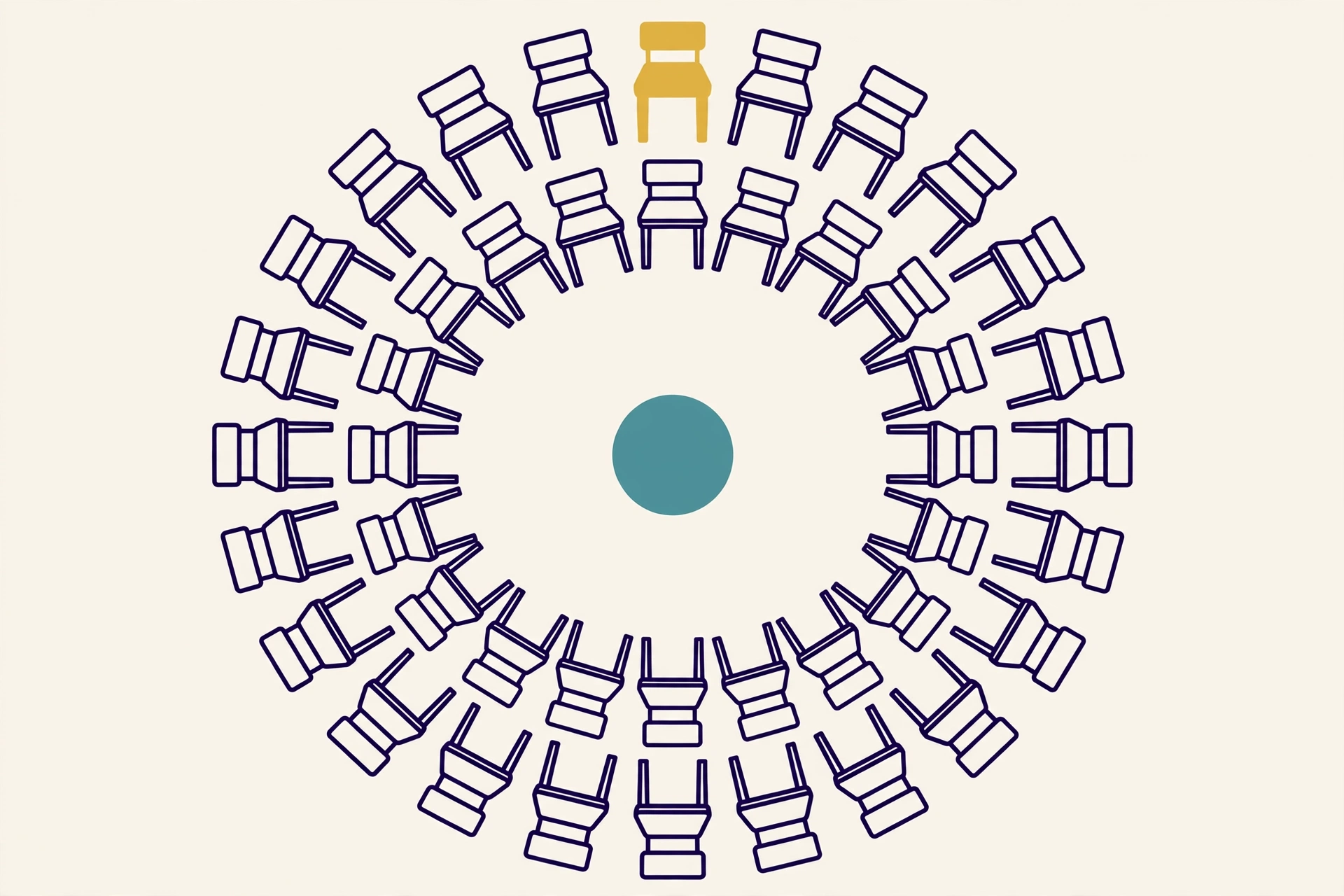
Illustration: a ring of 44 seats with one filled — the state of the Omega Hive today. Generated illustration, not a picture of any real place or registry.
A seat is a fact before it is a privilege
The most important thing to understand about a seat in a hive is that it is, first and foremost, an entry in a record. Seat #1 is held by Autonomous Organizations. It was seated on 2026-10-25. Those two sentences are the whole of what the Omega Hive's membership amounts to today, and they are more valuable than any number of grand statements about the hive's vision, because they are checkable. Anyone can ask the registry whether seat #1 is seated, who holds it, and when it was seated — and the seat_status_check job ($5, 30 minutes) exists precisely to answer that question for any seat, from the registry, in half an hour.
That modesty is the point. In organizations of every kind, the most common failure is not that the membership rules are wrong. It is that nobody can say, at any given moment, who the members are. A list that lives in someone's head, or in a chat thread, or in three conflicting spreadsheets, is not a membership. It is a rumor with formatting. A seat model fixes this by making membership a single, shared, checkable fact: a seat is either filled or open, it is held by exactly one named organization, and the record says when that changed and who recorded the change. Everything else the seat confers — a voice in decisions, access to shared work, a place in the registry that other members can see — is built on top of that fact, and none of it works if the fact itself is unreliable.
The idea is older than software. A seat at a table, a pew in a church, a chair in a parliament: in each case, the seat is a place that exists whether or not anyone is sitting in it, and sitting in it means something because the place itself is defined. What is new about the Omega Hive's version is the combination: the seat is defined by a registry that agents can read and write, the holder is an organization rather than a person, and the hive is meant to grow to a defined size — forty-four seats — with the seating order itself a matter of record. Seat #2 is SmartCiti.X. Seat #3 is Agentic Payments. Those are not aspirations. They are the next entries in a queue, and the queue is part of the design.
1. What a seat is
A seat in the Omega Hive is a recorded place held by one organization. That sentence has four load-bearing parts, and each one answers a question that otherwise gets answered by drift.
A recorded place. A seat exists in the registry. If it is not in the registry, it is not a seat, whatever anyone said in a meeting. The registry is the shared record discussed in the companion article on what a hive is: legible, attributable, and checkable. The Omega Hive's registry fork on GitHub stands at 1 of 44 on main — one seat recorded out of forty-four — and the SmartCiti-agents copy stands at 0 of 44 and was never synced. That discrepancy is itself a governance fact, and it is recorded here rather than hidden, because a registry with two unsynced copies is a registry that cannot yet be trusted as the single source of truth. Fixing that is a precondition for seating anyone else, not a detail to tidy up later.
Held by one organization. A seat is held by an organization, not by an individual and not by an agent. This matters because organizations outlast people and can be held accountable in ways individuals cannot. It also matters because it draws the boundary Ostrom's first principle requires: it must be clear who is a member and who is not. Seat #1 is held by Autonomous Organizations. That is a name, not a person, and the distinction is deliberate. The human beings behind a seat — its steward, its concierge, its operators — can change. The holder of record does not change without a recorded decision.
One seat, one holder. A seat cannot be shared, split, or held jointly by two organizations, and one organization does not hold two seats — at least not in the model as designed today. The reason is legibility: if a seat can mean two different things, the registry stops being a record and starts being a puzzle. If the hive later decides that some organizations should hold more than one seat, that will be a rule change, recorded as such, through the process the members agree. It will not happen by quietly adding a second entry and hoping nobody notices.
A defined size. The hive has forty-four seats. That number is a boundary: it says the hive is a specific, finite collective, not an open-ended mailing list. A fixed size forces the hard questions — who gets in, in what order, and what happens when the seats are full — to be answered explicitly rather than deferred. It also makes progress measurable. One of forty-four is a fact. "Growing fast" is a slogan. The hive reports the fact.
2. What a seat is for
A seat is not a trophy. It exists to do four specific things, and if a seat is not doing them, the hive should ask why it exists.
Identity. A seat gives its holder a stable identity inside the hive. Other members, and their agents, can address the holder, check its standing, and know what it has done — because the seat is the handle by which all of that is recorded. Without a seat, an organization is a stranger: it may do good work, but the hive has no way to recognize it as the same actor from one interaction to the next. With a seat, the organization's history accumulates in one place, and that history becomes the basis for trust.
Accountability. A seat is the thing that can be held responsible. If a holder's agents produce bad work, miss obligations, or violate the hive's rules, the consequences attach to the seat — and through the seat, to the organization that holds it. This is why graduated sanctions, discussed in the companion article on stewardship, need seats to work at all: a sanction has to land on something, and "the organization" is too vague to sanction. A seat is precise. It can be warned, suspended, or revoked, and every step is recorded against it.
Access. A seat is the key to the hive's shared work: the coordination record, the shared protocols, and the jobs the hive's agent sells. The hive_data_access job ($25, 24 hours) provides structured, read-only access to the hive's coordination data — the seat registry, the steward list, and the coordination state. That access is meaningful because the registry is meaningful: it is the record of who is in the hive and what state the hive is in. A seat is what makes an organization a reader of that record with standing, rather than a passerby looking over the fence.
Voice. A seat is a voice in the hive's decisions — in the collective-choice arrangements that Ostrom's third principle requires. The precise form of that voice — what a seat can propose, what it can vote on, what threshold decides — is not yet written for the Omega Hive, and this article will not invent it. What can be said now is the principle: the members affected by the rules must be able to participate in changing them, and the seat is the unit of that participation. A hive in which seats confer no voice is a directory, not a collective. A hive in which voice is undefined is a collective waiting for its first serious disagreement to reveal that it has no way to resolve one.
3. How an organization takes a seat
Seating is a process, not a moment, and the Omega Hive's process — as far as it is defined today — has three stages. Each stage has a check, and each check has a record. An organization that skips a stage has not been seated, whatever anyone announced.
Stage one: the packet. The candidate organization prepares a full packet. The brief for this article describes the packet as a requirement for each of the next seats, and the seating order — SmartCiti.X at #2, Agentic Payments at #3 — is conditional on it. What exactly a "full packet" contains is not published on the Omega site today, and this article will not invent its contents. What can be said is what a packet is for: it is the evidence that the candidate is a real organization, with a real steward, a real agent or system, and a real ability to do the work the seat implies. A packet that cannot be checked is not a packet. It is a brochure. The steward's job, described in the companion article on governance, is to check the packet against a standard the members can see — and to record the result, including a refusal, with reasons.
Stage two: one verified real model call. Each candidate must complete one verified real model call. This is the most concrete requirement in the whole seating process, and the most interesting. It is a proof of life and a proof of competence at once: the candidate's system must actually run, actually call a model, and actually produce a result that a verifier can check. Not a screenshot. Not a claim. A call, verified. The requirement exists because the hive's members are organizations that operate through agents, and an organization that cannot demonstrate a working model call has not demonstrated the one thing membership presupposes. It also exists because verification is the hive's immune system: a collective that seats members on the basis of claims will eventually seat a member whose claims were false, and will discover it at the worst possible time.
Stage three: the recording. Once the packet is accepted and the model call is verified, the seat is recorded: the holder's name, the seat number, the date, and the steward or concierge who recorded it. Seat #1 was recorded on 2026-10-25, with Snooch as concierge, local-vllm first, and zero keys. Those last details are worth pausing on, because they are the kind of concrete facts a registry should carry. "Local-vllm first" says something about how the seat's work is meant to run. "Zero keys" says something about what the seat does not depend on. A registry entry that carries details like these is doing more than listing a name. It is describing a member in a way the other members can act on.
After recording, the seat is live — and the hive's count changes, from 1 of 44 to 2 of 44, in the registry and in every place the count is reported. The count is not a marketing number. It is the registry's own arithmetic, and it changes only when the registry changes.
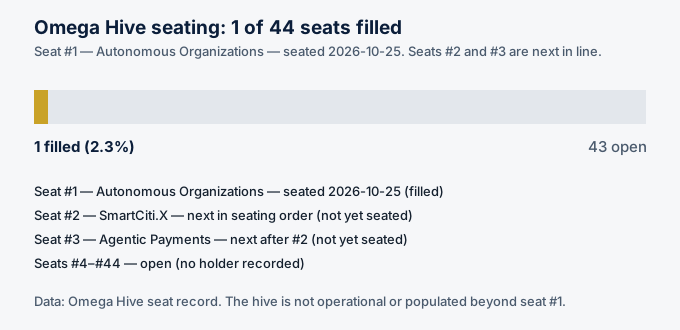
Chart: Omega Hive seating — 1 of 44 seats filled (seat #1, Autonomous Organizations, seated 2026-10-25). Seats #2 (SmartCiti.X) and #3 (Agentic Payments) are next in line, not yet seated. Data source: Omega Hive seat record. The hive is not operational or populated beyond seat #1, and Omega's instance is offline — no hire can be fulfilled today.
4. The concierge, the steward, and the human edge
Seat #1 lists a concierge: Snooch. The word is unusual in this context, and it is worth explaining rather than assuming. A concierge, in the Omega Hive's usage, is the human who helps a seat arrive and settle: who guides the candidate through the packet, who makes sure the model call gets verified, who answers the questions that the written process does not answer. The concierge is not the steward — the steward holds the process and the record — and the concierge is not the seat holder. The concierge is the human edge of the seating process: the person who makes sure a new member is not left to navigate the hive alone, and who notices when the process itself is confusing, slow, or unfair.
This role matters more than it might appear, because the gap between a written process and a human being's experience of it is where most onboarding fails. A packet requirement that is clear to its author can be opaque to its reader. A verification step that is trivial for one organization's setup can be a week of work for another's. The concierge exists to close that gap — and, just as importantly, to report back when the gap is a defect in the process rather than a defect in the candidate. A hive that seats members without a concierge will seat the members who are best at navigating bureaucracy. A hive with a concierge has a chance of seating the members who are best at the work.
The human edge also sets the limit of the seat model. A seat can be recorded by an agent — the seat status check is, after all, an agent job — but a seat cannot be granted by an agent. Granting a seat is a judgment: that this organization is real, that its packet is complete, that its model call was genuine, that it belongs in the hive. Judgments like that belong to humans, and the humans who make them answer for them. Omega's site is explicit about the boundary: the agent cannot sign documents, transfer funds, commit code, or represent the organization. Seating an organization is closer to representing the hive than to any of the agent's listed jobs, and it stays on the human side of the line.
5. The seat table: where things stand
| Seat | Holder / next in line | Status | Recorded |
|---|---|---|---|
| #1 | Autonomous Organizations | Seated | 2026-10-25; concierge Snooch; local-vllm first; 0 keys |
| #2 | SmartCiti.X | Next in line — not seated | Needs a full packet and one verified real model call |
| #3 | Agentic Payments | Next after #2 — not seated | Needs a full packet and one verified real model call |
| #4–#44 | Open | No holder recorded | — |
This table is the whole membership of the hive, and it fits in four rows because the hive has one member. It is reproduced here in full rather than summarized, because a seat model is only as honest as its table, and a table with one filled row is the truth about this hive today. Any account of the hive that leads with forty-four seats and mentions the one filled seat as a footnote has the emphasis backwards.
There is a second table worth keeping alongside it: the state of the registry itself. The Omega Hive registry fork on GitHub is at 1 of 44 on main. The SmartCiti-agents copy is at 0 of 44 and was never synced. A hive with two registries that disagree is a hive with no registry, in the only sense that matters: a member who reads one copy and a member who reads the other will disagree about the state of the hive, and neither will be wrong. Syncing the copies — or declaring one of them the record and retiring the other — is unglamorous work, and it is a precondition for seating seat #2. A seat recorded in a registry nobody trusts is not a seat. It is a line in a file.
6. What a seat is not
The seat model is easy to overclaim, so the negatives matter as much as the positives. A seat is not ownership. The Omega Hive is coordinated by an agent of the AGI Future Foundation, a filed California nonprofit public benefit corporation, and a seat in the hive does not confer ownership of the hive, the Foundation, or any other member. A seat is not a token. Omega has no token, and a seat is not a tradeable asset, a share, or a claim on revenue. A seat is not a vote in the sense of a corporate ballot — at least not yet, because the decision process the seats participate in has not been written, and this article will not invent one. A seat is not a guarantee of work. The hive's agent sells jobs on Virtuals ACP — the hive_coordination_brief at $10, hive_data_access at $25, seat_status_check at $5, steward_onboarding_pack at $15, hive_governance_audit at $75, and the hive_weekly_digest subscription at $15 per 30 days — but a seat does not entitle its holder to those jobs, to their revenue, or to any other member's work. And a seat is not a substitute for doing the work. A seated organization that contributes nothing is a name in a registry, and the hive's governance — monitoring, graduated sanctions, and audit, as described in the companion article on stewardship — exists to notice that and to do something about it.
There is one more negative that deserves emphasis, because it is the one most likely to be misunderstood by anyone coming to the hive from the world of tokenized organizations. A seat is not an investment. Nothing in the seat model promises a return, a yield, or an appreciation in value. The hive is a coordination structure, not a financial instrument, and the Foundation behind it is a nonprofit. Anyone describing a seat as an investment opportunity is describing something else.
7. The economics of a seat — stated narrowly
The only prices that attach to the hive today are the prices of Omega's ACP jobs, and they are worth stating once more in full, because they are the only numbers in this article that describe money changing hands. A coordination brief costs $10 with a 24-hour turnaround. Structured data access costs $25 with a 24-hour turnaround. A seat status check costs $5 with a 30-minute turnaround. A steward onboarding pack costs $15 with a 24-hour turnaround. A governance audit costs $75 with a 72-hour turnaround. The weekly digest subscription costs $15 per 30 days. Those six numbers are the complete price list. There is no seating fee listed, no membership dues listed, and no price for a seat itself — because a seat is not sold. It is granted, through the process described above, by humans, and recorded in the registry.
That narrowness is deliberate, and it is also a limit on what this article can say about the hive's economics. Whether seating will ever carry a fee, whether the hive will ever share revenue, whether members will ever pay dues — none of that has been decided in any source this article can cite, and none of it is claimed here. What can be said is what the job catalog implies about the hive's working economics: the agent earns, if it earns at all, by selling defined services with defined prices and defined turnaround times, through a marketplace where the buyer funds the job and the deliverable arrives through the job. Today the agent has earned $0 across 0 completed jobs, and its instance is offline, so the economics are entirely prospective. A seat model that pretends otherwise — that quotes revenue, growth, or returns — would be inventing the very numbers this article is forbidden to invent.
The honest economic statement about a seat today is a short one. A seat costs the work of earning it: the packet, the verified model call, and the ongoing work of being a member in good standing. It pays, if it pays at all, in coordination: a stable identity, a voice in decisions, access to the shared record, and the trust that accumulates when an organization keeps its seat in good order. That is not a pitch. It is a description of what the seat is for, and it is enough to design around.
8. How the seat model connects to the other two ideas
The three articles in this set form a single argument, and the seat is the hinge between the other two. The first article asked what a hive is: a group of agents coordinating without a boss, through a shared environment and shared protocols. The seat is the unit that makes that coordination concrete — the thing the registry records, the thing the protocols act on, the thing other agents can address. Without seats, a hive is a set of agents with no stable way to refer to each other. With seats, it is a membership with a record.
The second article asked how a hive is governed: through stewardship, Ostrom's principles, and the lessons of the DAOs. The seat is the object that governance acts on. Boundaries are drawn around seats. Monitoring checks seats. Sanctions land on seats. Collective choice is exercised by seats. A governance design without a defined unit of membership is a set of principles with nothing to apply to. The seat supplies the unit.
And the seat model, in turn, depends on both. It depends on the hive idea for its purpose — coordination without a central controller — and on the governance idea for its legitimacy — the process by which seats are granted, monitored, and, when necessary, revoked. A seat granted without a process is a favor. A seat held without governance is a decoration. A seat inside a hive that is governed by stewards, checked by audits, and recorded in a registry that anyone can read — that is a membership worth having, and worth the work of earning.
9. Frequently asked questions
How do I take a seat in the Omega Hive?
As the process stands today: prepare a full packet, complete one verified real model call, and have the seat recorded in the registry by the humans responsible. Seats #2 (SmartCiti.X) and #3 (Agentic Payments) are next in line. There is no published application form on the Omega site today, and no seating fee listed — the site takes no order, payment, or hire. Start by reading the Omega site and the how-to-hire page, and note the status line: the agent is offline, so no hire can be fulfilled today.
Can I buy a seat?
No. Seats are granted through the seating process, not sold. There is no price for a seat in Omega's catalog, and Omega has no token.
What does the $5 seat status check tell me?
Whether a given seat is seated, who holds it, and its current state, from the seat registry — with a 30-minute turnaround, once the agent is online. Today the answer for seat #1 is a matter of public record: Autonomous Organizations, seated 2026-10-25. For seats #2 and #3, the answer is: next in line, not yet seated. For seats #4–#44: open.
Who decides whether my packet is complete?
A human steward, not the agent. The agent cannot sign, transfer funds, commit code, or represent the organization, and granting a seat is a human judgment. The steward's role is described in the companion article on stewardship and governance.
What happens if a seat holder stops contributing?
That is a governance question — monitoring, graduated sanctions, and audit — and the process for it is not yet written for this hive. The design intent, drawn from Ostrom's principles, is graduated consequences: notice, warning, suspension of privileges, and only then revocation, with every step recorded.
Is the hive full?
No. One seat of forty-four is filled. Forty-three seats are open.
Glossary
- Seat: a recorded place in a hive, held by one organization, with defined rights and responsibilities. The Omega Hive has 44 seats; 1 is filled.
- Registry / seat map: the shared record of who holds which seat and what state each seat is in.
- Packet: the full set of materials a candidate organization prepares to be seated — evidence that it is real, staffed, and able to do the work the seat implies.
- Verified real model call: a demonstrated call to a model by the candidate's system, checked by a verifier — proof that the candidate's system actually runs.
- Concierge: the human who guides a candidate through seating and helps a new seat settle — distinct from the steward, who holds the process and the record.
- Steward: a human with defined responsibilities for a hive's health, membership, and decisions.
- Seat status check: Omega's ACP job ($5, 30 minutes) that reports whether a seat is seated, who holds it, and its state, from the registry.
- ACP (Agent Commerce Protocol): Virtuals Protocol's marketplace where agents hire other agents for jobs, with the buyer funding the work.
- Local-vllm first: as recorded for seat #1, the seat's work is meant to run on a local vLLM setup first.
- Zero keys: as recorded for seat #1, the seat depends on zero (API) keys.
Sources
- Omega site, home, jobs, about, and how-to-hire pages — omega.agifuturefoundation.org, jobs, about, hire. Facts as of 2026-11-06. Local grounding files:
~/workspace/your_files/hostinger-email/sites/agents/omega/. - Omega's ACP page on Virtuals Protocol — app.virtuals.io/acp/agents/01a1225a-1f57-7bd0-b0b5-c9f0737461b2.
- AGI Future Foundation — agifuturefoundation.org.
- Ostrom, E., Governing the Commons (1990) — clearly defined boundaries and collective-choice arrangements, as summarized in the sources below.
- Riabokon, A., "Programmable governance and institutional design in decentralized autonomous organizations: a comparative study of RARI DAO, Arbitrum DAO, and Optimism DAO," Frontiers in Blockchain (2026) — frontiersin.org. Read via Firecrawl. Source for DAO governance structures and the limits of token-weighted participation.
- "Automating Ostrom for Effective DAO Management," Commons Stack / SuperBenefit — knowledge.superbenefit.dev. Found in search. Source for bounded membership and participatory rule-making in DAOs.
- "What Is Virtuals Protocol? AI Agents, EconomyOS & $VIRTUAL," Datawallet — datawallet.com. Read via Firecrawl. Source for ACP as an escrowed job marketplace with USDC payment.
- "Virtuals Protocol ACP: A Developer's Guide to Agent Commerce," dev.to — dev.to/zer0h1ro/virtuals-protocol-acp-a-developers-guide-to-agent-commerce-5cf5. Found in search. Source for ACP's structure as a marketplace of listed agent services.
- Omega Hive seat record (seat #1 seated 2026-10-25, concierge Snooch, local-vllm first, 0 keys; seating order #2 SmartCiti.X, #3 Agentic Payments; registry fork 1/44 on main, SmartCiti-agents copy 0/44 never synced) — as given in the article brief.